
You’re not the only one who keeps seeing the phrase “double 90 handrails” when you plan a staircase. Most homeowners don’t know what they are until they are in the middle of a stair project and can’t figure out why the handrail on their L-shaped or switchback staircase won’t connect cleanly around the corner. This fitting starts to make sense right then.
This is a simple, clear explanation of what double 90 handrails are, which staircases need them, and how to make sure yours is done correctly.
What is a double 90 handrail?
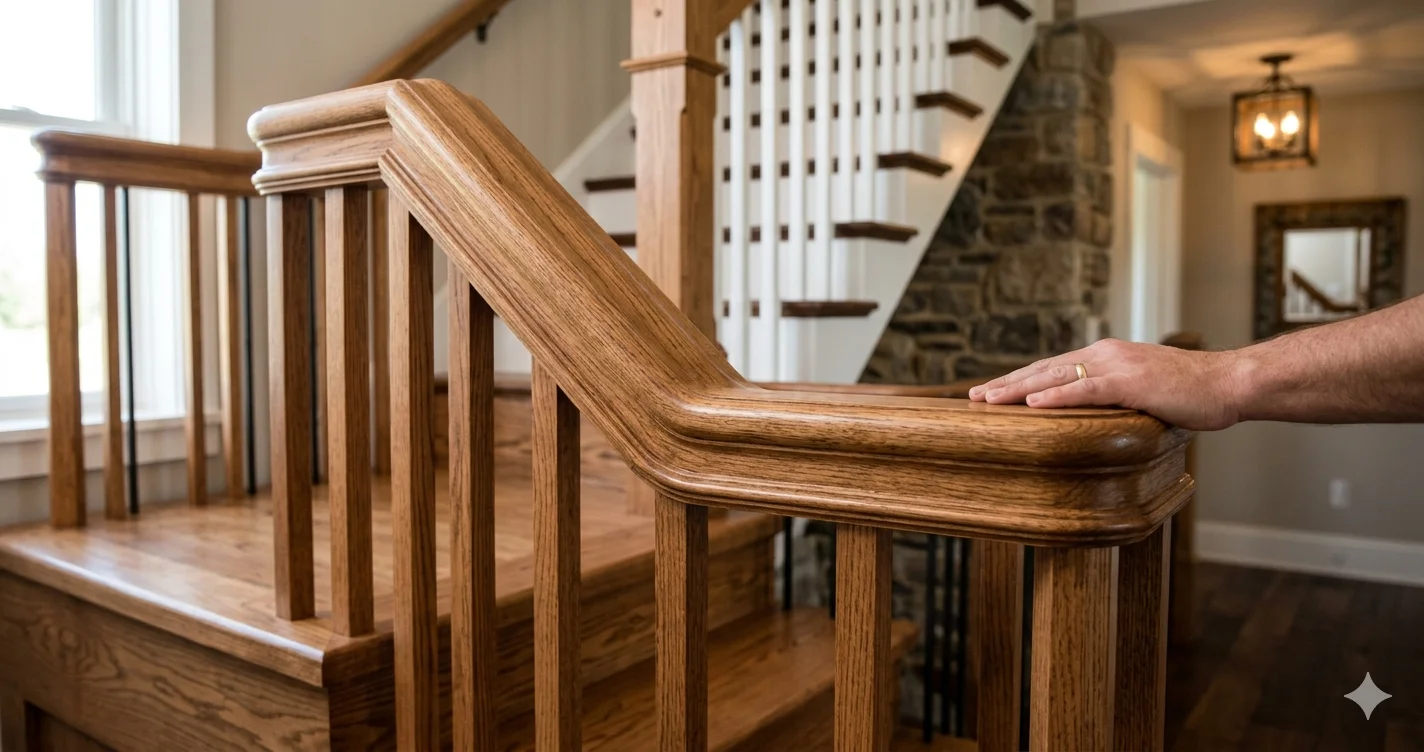
A double 90 handrail is a type of handrail fitting that makes two 90-degree turns in one piece. One turn goes up, and the other goes horizontally around a corner. Think of it as a piece of wood that fixes a very specific problem: what happens to your handrail when the stairs turn at a landing.
Your handrail runs in a straight line from the bottom to the top of a straight staircase. Simple. But the handrail has to go around the turn without breaking, dropping, or looking like it’s been put together with tape when the stairs turn, like on an L-shaped stair or a switchback. The double 90 is what you need.
The American Institute of Building Design calls the standard single version of this fitting a “over easing.” This is a part of a handrail that bends the rail from a raked angle to a level one. The double 90 takes that idea even further by using one fitting to change both the vertical and horizontal directions at the same time. The result is a handrail that goes around the corner smoothly, with no gaps or joints that look strange.
What staircases need a double 90 handrail?
Not all staircases need one. You don’t need a double 90 fitting at all if your pipe is straight from top to bottom. But the answer changes quickly if your stairs turn.
Stairs in the shape of an L
One of the most common types of stairs in homes, especially cabins and two-story houses with small hallways, is the L-shaped staircase, which is also known as a quarter-turn or 90-degree staircase. The stairs go up, hit a landing, and then turn 90 degrees before going up to the second floor. The handrail needs to make the same turn at the landing, and a double 90 fitting lets it do that without any problems.
Stairs with Switchbacks
A switchback staircase goes 180 degrees, usually with one or two landings. You can find these in many old Michigan farmhouses and cabin-style homes where the stairs don’t take up much floor space. The handrail at the landing has to turn completely around, and a double 90 fitting makes the change at the corner of each landing turn.
Stairs with doglegs
Some staircases have an angled or “dogleg” section where the stairs don’t make a clean right angle, but instead turn slightly. A double 90 fitting can also help these, but the exact shape will depend on how sharp the turn is.
This is the easiest way to find out what kind of stairs you have: stand at the bottom and look up. You probably need a double 90 handrail at the transition point if the stairs go in more than one direction before reaching the top floor.
Why it’s important to get this fitting right
You might think that a handrail fitting is a small thing. It isn’t. The corner of your stairs is one of the most used and touched parts of the whole thing. People hold on to the rail the hardest when they are going up or down the stairs, especially kids, older people, and people carrying something. A loose, mismatched, or poorly installed fitting at that corner is a serious safety issue.
There is also the visual side, in addition to safety. Getting a clean, continuous handrail around a stair corner is one of the trickier parts of any stair project, according to Fine Homebuilding. The fitting has to change from a raked (angled) section of rail to a level one while also turning direction, all without leaving any gaps, proud joints, or mismatched grain. When built correctly, a custom-fitted double 90 handles all of that in one piece.
A stock fitting from a big-box store might be close, but it won’t match the profile, wood type, or finish of a handmade staircase. When everything is put together and stained, the difference becomes very clear.
Custom Double 90 Handrails vs. Stock Parts
Stock handrail fittings are made to fit a few standard handrail profiles, which are usually made of red oak or poplar. A stock fitting can work if your stairs have one of those exact profiles and species. But if your stairs are custom-made with a certain type of wood, a certain shape, or a rough finish, a stock double 90 fitting won’t match. The grain won’t match, the stain won’t work the same way, and the joint will show.
That’s the difference between getting a part made and ordering one. At Country Neighbors, we make custom handrail fittings, like double 90s, that fit your stairs perfectly, no matter what type of wood or finish you have. The goal is always the same, whether you’re building a new rustic staircase or replacing a fitting on an old one: to make the handrail look and feel like it was grown that way, not put together.
You can look at our rustic staircase work to see how we take care of the details that stock parts can’t.
So, do you really need one?
The short answer is yes, you need a double 90 handrail fitting at that corner if your staircase turns at a landing and you want a safe, code-compliant handrail that looks finished. If you want the rail to work right, you have to do it. You just have to decide if you want a stock one that almost fits or a custom one that fits perfectly.
The end
Double 90 handrails are small but very important. They hold your handrail together, keep it safe, and make it look good at the hardest part of the stairs, which is the turn. If your stairs have an L-shape, a switchback, or any other corner landing, you don’t want to guess about this fitting or try to fix it after the fact.
If you want it done right the first time with wood that really matches your stairs, get in touch with Country Neighbors. We make these fittings by hand, to your exact specifications, in the type of wood and finish that will look best on your stairs.


On all items, anywhere in the United States!
Pick the rustic styled ladders, stairs, unique wooden items, choose the color and Elevate your home’s style.